Dr. Zezhu Zeng

Newton International Fellow
Department of Chemistry, University of Oxford
Physical and Theoretical Chemistry Laboratory · Oxford, UK
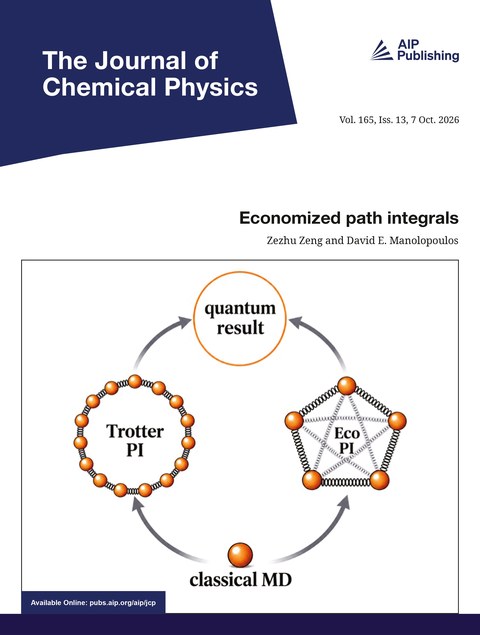
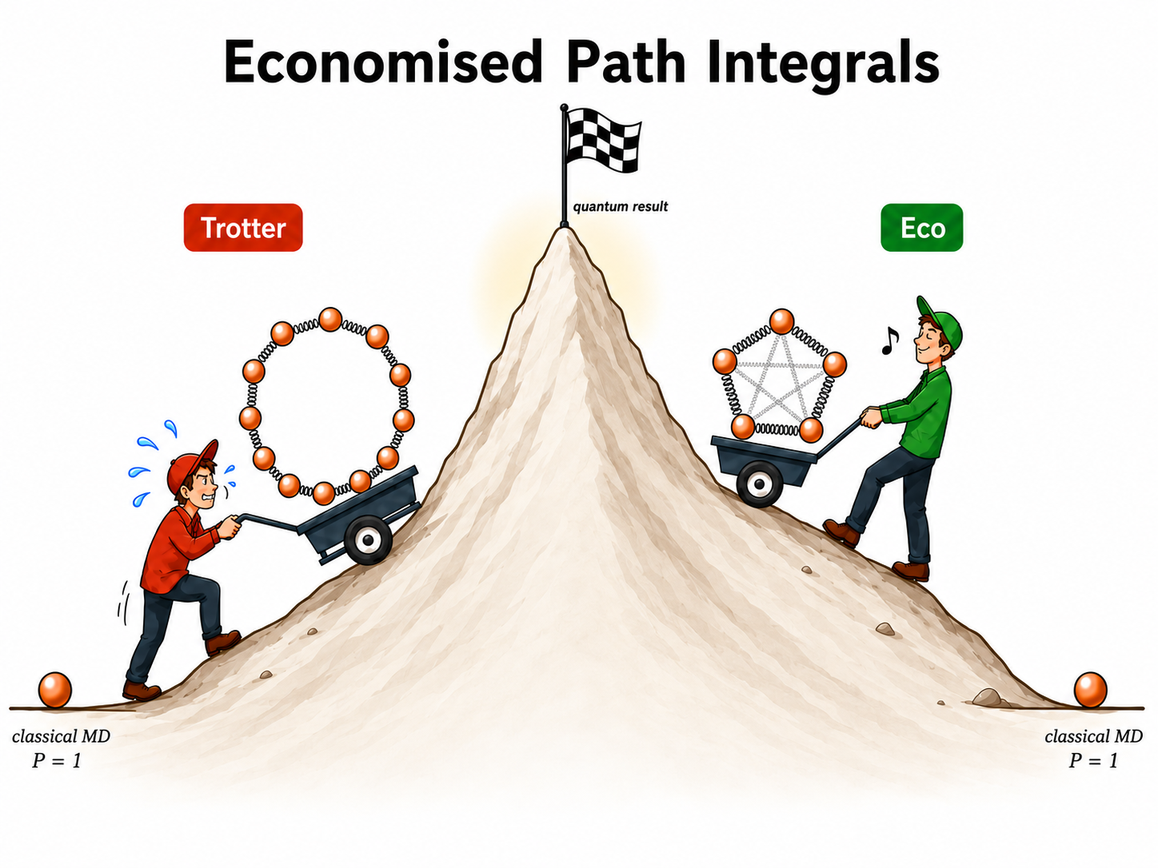
NewsOur Economized path integrals paper is an Editor’s Pick and the cover article of J. Chem. Phys. →
Dr. Zezhu Zeng
About me

I am a computational material physicist currently based at the University of Oxford as a Newton International Fellow, working with Prof. David Manolopoulos FRS in the Department of Chemistry. My research sits at the intersection of condensed matter physics, materials physics, and machine learning — with a particular focus on atomistic simulation across condensed matter.

I completed my PhD at the University of Hong Kong under Prof. Yue Chen, before holding a Marie Skłodowska-Curie Fellowship at IST Austria with Prof. Bingqing Cheng (UC Berkeley).My research spans lattice dynamics, heat transport, nuclear quantum effects, and interfacial chemistry.

I am particularly interested in developing and applying advanced computational methods, including machine-learning interatomic potentials, anharmonic lattice dynamics, and classical and path-integral molecular dynamics, to understand the microscopic mechanisms governing the behaviour of condensed matter. By combining first-principles accuracy with large-scale atomistic simulations and quantum statistical mechanics, I aim to unravel complex physical phenomena in a broad range of materials, from conventional semiconductors and perovskites to metal–organic frameworks, quantum solids, and water–oxide interfaces.

Research interests
01
Lattice Dynamics
Phonon heat transport
02
Path Integrals
Nuclear quantum effects
03
Data-Driven Modelling
Machine-learning interatomic potentials and their applications
04
Interface Chemistry
Water dissociation mechanism on oxide surfaces
Career & education
2025 – present
Newton International Fellow
University of Oxford, Department of Chemistry · UK
03/2023 – 03/2025
Marie Skłodowska-Curie Fellow
IST Austria · secondment at University College London
Collaborators: Prof. Bingqing Cheng (UC Berkeley now) · Prof. Geoff Thornton (UCL)
09/2018 – 12/2022
PhD, Mechanical Engineering
The University of Hong Kong
Supervisor: Prof. Yue Chen
09/2014 – 06/2018
BS, Engineering Mechanics
Huazhong University of Science and Technology · Wuhan, China
GPA Rank 2/47 (90.99/100) · Comprehensive Rank 1/47
Grants & honours
2025
Newton International Fellowship (£284,000)
Royal Society of the UK
2024
Best Thesis Award 2021–2022
The University of Hong Kong
2023
Marie Skłodowska-Curie Postdoctoral Fellow (No. 101034413)
European Union Horizon 2020 · IST Austria
2022
M. Braun Postgraduate Prize
The University of Hong Kong
2018
Y S and Christabel Lung Postgraduate Scholarship
The University of Hong Kong
2017
National Scholarship of China
Ministry of Education, People's Republic of China
2016
National Scholarship of China
Ministry of Education, People's Republic of China
Invited talks
2025
Lattice distortion leads to glassy heat transport in perovskites
International Symposium on Multiscale Simulations of Thermophysics (MSTP-2025)
30 min · invited speaker
2024
Lattice thermal transport of solids from first-principles
Conference of Condensed Matter Physics 2024, China
30 min · invited speaker
2023
Water dissociation on pristine low-index TiO₂ surfaces
Bridging length scales with machine learning: from wavefunctions to thermodynamics · Freie Universität Berlin, Germany
45 min · invited speaker
Selected work

A few projects that best capture the questions I care about. For the complete and continuously updated list of publications, see my Google Scholar profile.

Phonon spectral density beyond perturbation theory images/work-anharmonic.png
02

Heat transport beyond perturbation theory

Zezhu Zeng, M. Simoncelli, D. E. Manolopoulos
Phys. Rev. B 114, 204303 (2026)

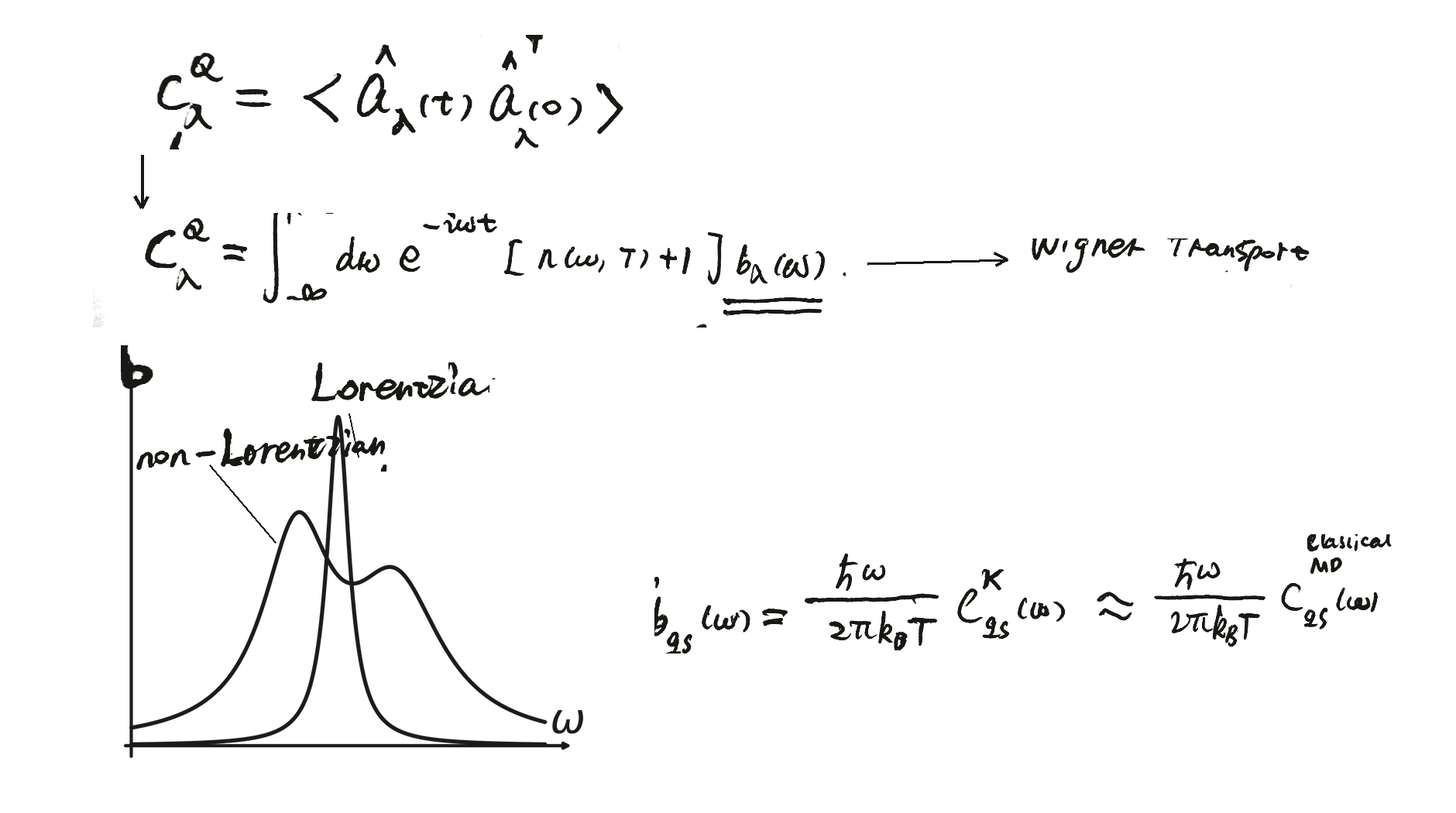
We introduce a molecular-dynamics route to the phonon spectral function that goes beyond standard perturbation theory. Because classical dynamics reproduces the exact quantum (Kubo-transformed) correlator for harmonic modes, the method extends cleanly to strongly anharmonic crystals — capturing both sharp quasiparticle peaks and broad non-Lorentzian lineshapes, and connecting directly to Wigner heat transport. Benchmarked on PbTe and on the strongly anharmonic halide Cs₃Bi₂I₆Cl₃, it reproduces measured thermal conductivities.

Water dissociation mechanisms on low-index TiO2 surfaces images/work-water.png
03

Water dissociation visualization from Machine learning techniques

Zezhu Zeng, F. Wodaczek, K. Liu, F. Stein, J. Hutter, J. Chen, B. Cheng
Nature Communications 14, 6131 (2023)

Using machine-learning molecular dynamics, we mapped how water splits on seven pristine TiO₂ surfaces — predicting which facets favour dissociation and which keep water intact, and resolving the distinct one-step and two-step proton-transfer pathways behind each. The study shows that the commonly studied anatase (101) and rutile (110) faces alone cannot capture how TiO₂ reacts with water.

Read the paper →
Glassy thermal transport in crystalline Cs3Bi2I6Cl3 images/work-distortion.png
04

Glassy heat transport in lattice-distorted crystals

Zezhu Zeng, Z. Fan, M. Simoncelli, C. Chen, T. Liang, Y. Chen, G. Thornton, B. Cheng
Proc. Natl. Acad. Sci. U.S.A. 122, e2415664122 (2025)

Cs₃Bi₂I₆Cl₃ is a crystal, yet it conducts heat almost like a glass. We traced this to intrinsic lattice distortion, which reshuffles the vibrational modes so that heat is carried less by particle-like phonons and more by wave-like tunnelling between modes — the Wigner two-channel regime. This explains how a fully ordered crystal can reach the ultralow, glass-like thermal conductivity usually reserved for amorphous solids.

Read the paper →

Dr. Zezhu Zeng · University of Oxford · zezhu.zeng@chem.ox.ac.uk